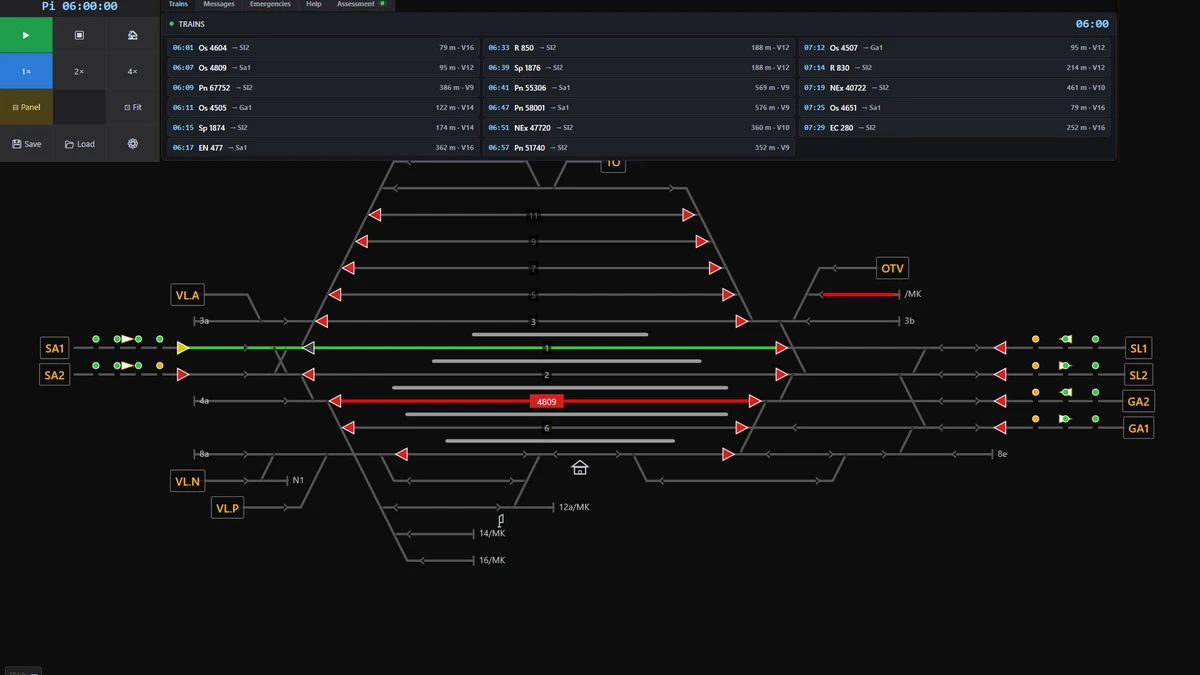
In Prime Rail Control, your assessment score is based on trains that leave your area or reach their terminal station correctly, minus penalties for mistakes, delays, and unsafe operating decisions. To score well, keep each train on its booked track, prevent avoidable delays—especially for express and international services—and avoid cancelling routes in front of approaching trains or authorizing departures without line consent.
How basic points are awarded
Each train that completes its assessed movement earns basic points according to its type. The train's penalties are then subtracted from that amount. Stopping a passenger train on its booked track adds one extra point.
| Train type | Basic points |
|---|---|
| EN, EC, or IC | 20 |
| Ex, R, or Sp | 18 |
| Os | 15 |
| Ordinary freight | 5 |
The booked track matters for passenger trains. A passenger train sent to another track can stop there, but the assessment treats that as a mistake. A passenger train routed through a track without a platform stops at the exit signal and produces a mistake message. Freight trains stop in front of the exit signal, and their track is not assessed in the same way.
Major penalties to avoid
| Action or problem | Penalty |
|---|---|
| Cancel a route in front of an approaching train | -15 |
| Let a train depart onto the line without line consent | -10 |
| Skip a required call-on signal step | -6 to -8 for each skipped step |
| Leave an emergency control active for more than two minutes | -5 for each control |
| Give a call-on signal | -3 |
Managing delays for a higher score
Only delay gained inside your area is assessed. For example, if a train arrives ten minutes late and leaves twelve minutes late, your area contributes two minutes of delay. Delay during the first five minutes after starting is not counted, giving you time to inspect the situation.
Delay penalties apply after the country's tolerance has been exceeded. The tolerance is five minutes in most countries, three minutes in Switzerland, six minutes in Germany, and one minute in Japan. Express and international trains are particularly expensive to delay: their penalty is two to three points per minute above the tolerance. During the busiest hours, delay penalties are reduced to one-half or one-quarter.
Practical scoring priorities
- Give express and international trains precedence when conflicts require a choice.
- Set routes early enough for trains approaching their departure time, but do not cancel a route in front of an approaching train.
- Check that passenger trains reach their booked platforms and tracks.
- Use a call-on signal only when there is no other way to handle the movement.
- Return emergency controls within two minutes.
- Remember that a lower traffic range reduces the positive points because fewer timetable trains run.
Reviewing the result
Open the Assessment tab to see the points gained, the attainable maximum, your percentage, and a separate row for every scored action. Use those rows to identify whether lost points came from track mistakes, operating penalties, or delay. The train graph, opened with G, can also help you compare the scheduled and actual running of trains while the scenario is in progress.